
DISPATCH - Apr 23, 2012 (8:05 a.m.)
LINCOLN, MA
I went on a road trip to deCordova Sculpture Park and Museum to catch the final weekend of the second Biennial of artists from the region. Meanwhile, it goes against the laws of art (if there is such a thing) to ignore the offering of sculpture installed in places that enhance the art and the nature surrounding it.
There are currently 55 artworks set on 35 acres. Contributing artists include Sol LeWitt, Nam June Paik, Roy Lichtenstein, Boaz Vaadia, Chakaia Booker, Ilan Averbuch, Ursula von Rydingsvard, Beverly Pepper, Dorothy Dehner and others.
The works range in medium, style and genre. Modern and Contemporary art are both represented. Some works are site specific; others are curated to harmonize with the landscape. Here's a small fraction of the sculpture on view:
.
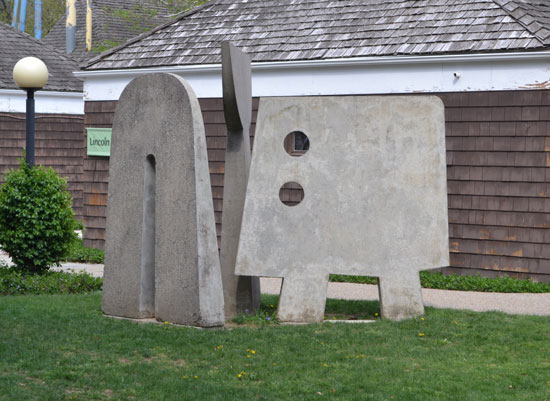
"Group of Three - the Pembroke Piece" by Hugh Townley, (1923 - 2008) 1969. Concrete.
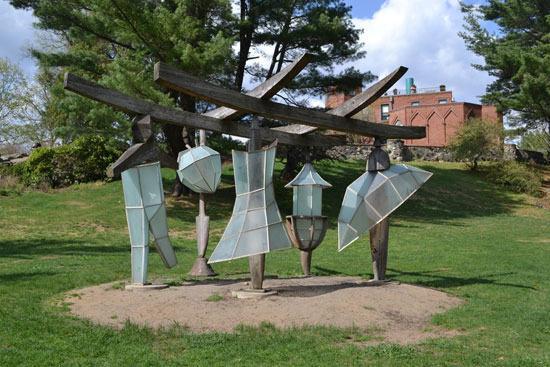
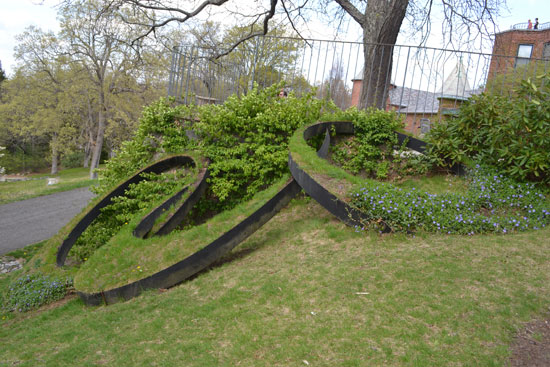
"Skirts and Pants (after Duchamp)" by Ilan Averbuch, 2000. Etched glass, wood. Artwork is courtesy of Nancy Hoffman Gallery (New York, NY).
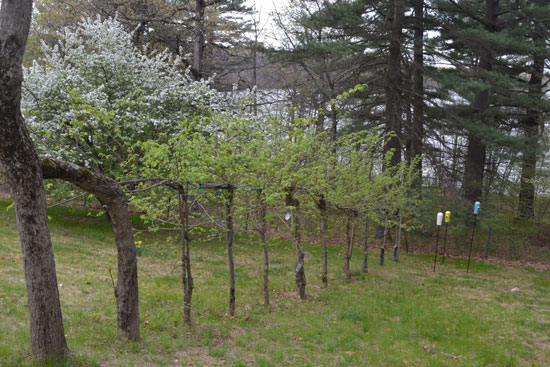
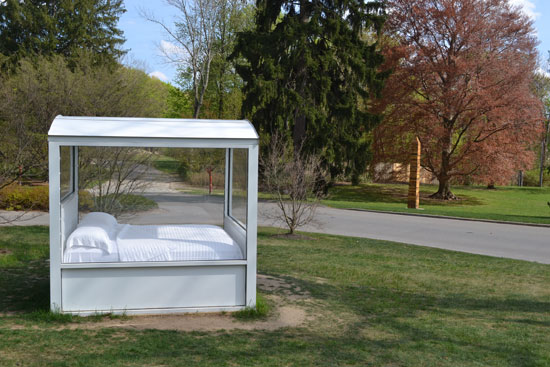
"Bannister Trees" by Daniel Ladd. Began 1990. 11 American Liberty Elm trees. A temporary site specific installation.
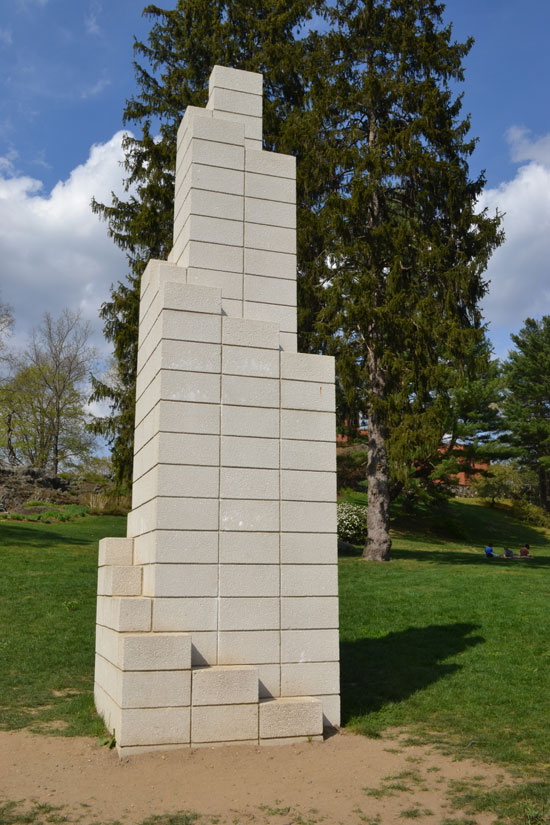
"Tower (DC)" by Sol LeWitt (1928-2007), 1989/2009. Concrete block and mortar. Artwork courtesy of Barbara Krakow Gallery (Boston, MA) and the Estate of Sol LeWitt.
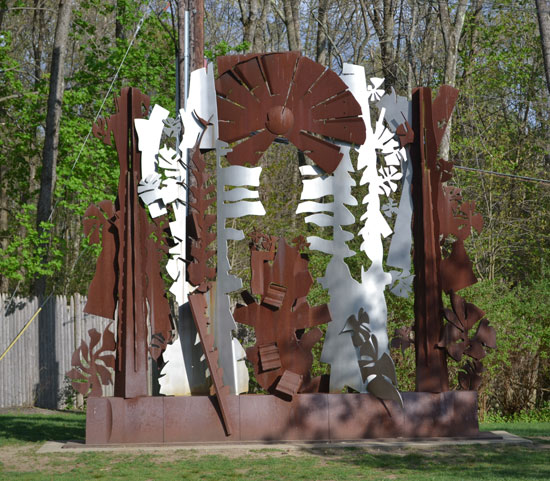
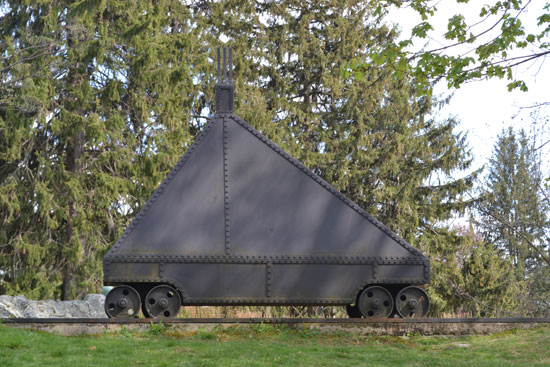
"Apollo" by Albert Paley, 1996. Weathering steel, stainless steel.
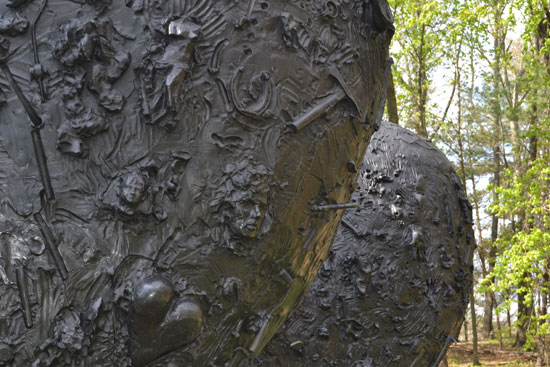
Detail of "Two Big Black Hearts" by Jim Dine, 1985. Bronze.
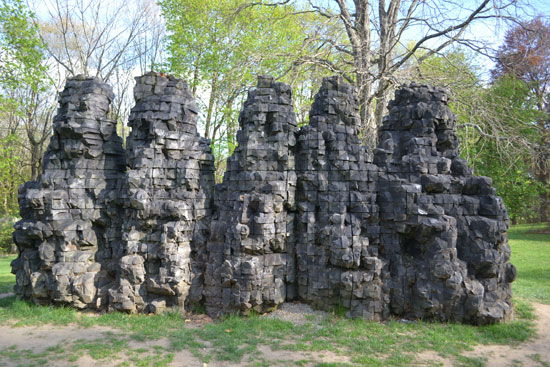
"Ence-Pence" by Ursula-von-Rydingsvard, 1997. Cedar and graphite.
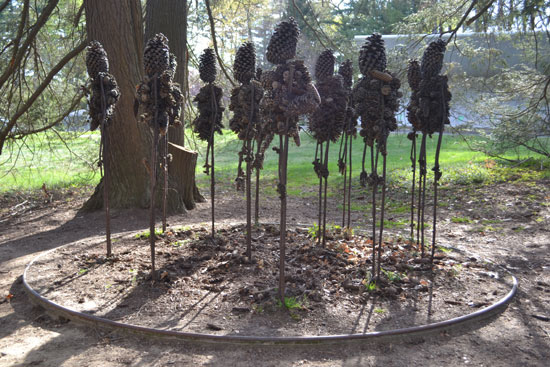
"Cones" by Ronald Gonzalez, 2006. Steel, natural materials. Site-specific installation.
.
There were some sculptures that sparked my imagination and engaged me beyond close examination.
"Venusvine" by Richard Rosenblum (1940-1999) had me wondering if I was imagining a mythical creature of the wood folk or if it was really a sculpture. It blended into the tree and shrub skyline as a natural element. Still, I wondered if it could be art.
The slim silhouette repeatedly called my eye...even while I was concentrating on other works. I approached the vine-like mystery from "Alice's Garden," a sloped garden with a stone walkway. Naturally landscaped, it has sculptures installed throughout. Only after standing some five feet away from the piece was I finally rewarded--a green informational panel revealed two things: Yes, it was a sculpture. No, it wasn't plant material. It was made of bronze.
.
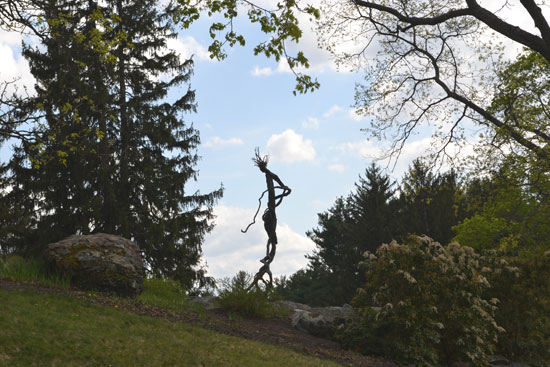
"Venusvine" by Richard Rosenblum (1940-1999), 1990. Bronze.
.
Steven Siegel's "Big, with rift" was a favorite. A sign pointed the way to the site specific installation with good reason. The work is located in a wooded corner of the sprawling property. It's also below ground. Walking toward the piece, all that's visible are tops of stacks holding brush, dead leaves and the first sprouts of spring plants. Gazing into the pit, it became apparent that "Big, with rift" is made from piles of newspapers. It was like looking into a canyon and discovering a natural wonder.
The elements had begun to have their way with the dead issues of the "Worcester Telegram and Gazette." Sunshine had yellowed the crevices in the towers of crisscrossed paper. I worked for newspapers for around 14 years. The installation made me glad that someone's discarded stories had gone to a better purpose than refuse in a landfill, bird-cage liner, fish wrap or material to stuff around precious objects when shipped. My connection to the material wasn't the only reason I connected with the installation. Viewing "Big, with rift" was like taking a walk in the woods and accidentally discovering a secret rock formation that is special to those who know about it.
"Big, with rift" is probably getting better with time. The transformation gave rise to an array of colors and captures different states of decay while being a vital part of a living and natural world. The texture mirrored the stone walls that surround it. Blue from headlines and photographs on the top of the "split page" reminded of the importance that newspapers once had as the sole harbinger of news.
Walking through the "rift" was a harrowing experience. The passage was wide enough to pass through but not without brushing against the canyon created by paper. Decay was close. It was uncomfortable.
Gazing at "Big, with rift" from above and from alongside, I found the installation beautiful and in harmony with its natural home.
.
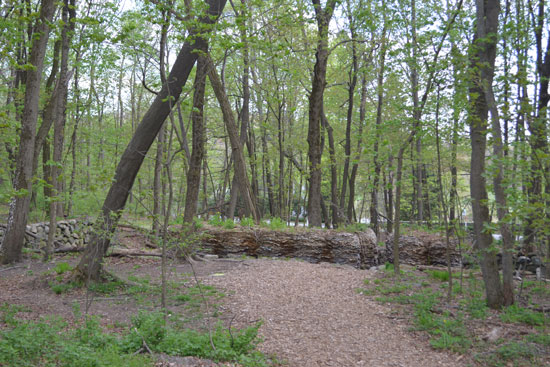
Approaching "Big, with rift" by Steven Siegel, 2009. Paper and flora.
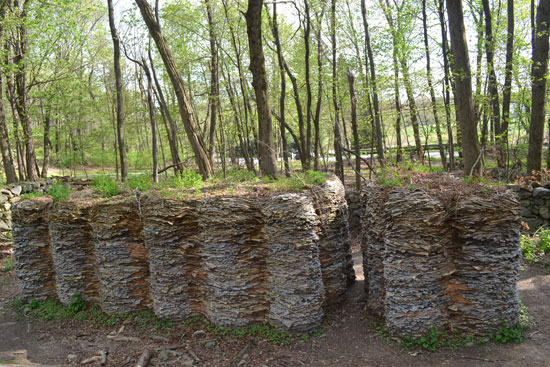
"Big, with rift" by Steven Siegel, 2009. Paper and flora. Site-specific installation.
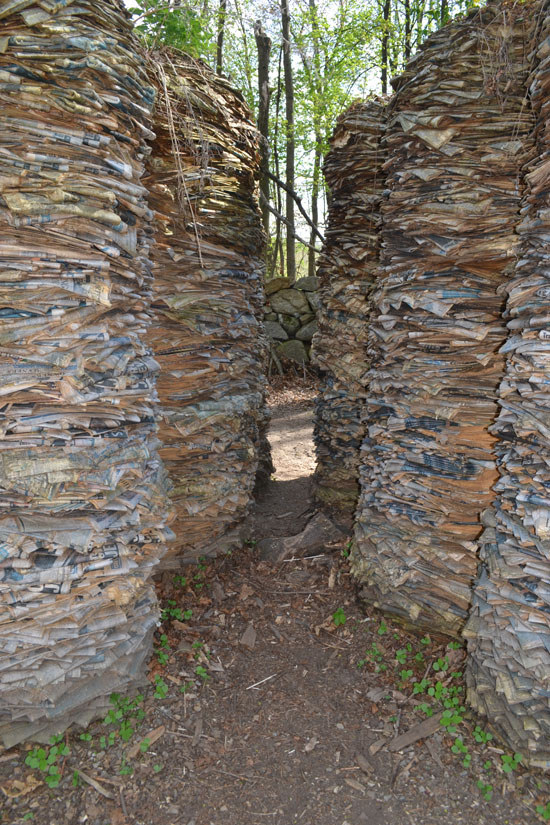
Detail of "Big, with rift" by Steven Siegel, 2009. Paper and flora. Site-specific installation.
.
"Humming" by Jaume Plensa grabbed my attention while driving into the park. A closer look did not disappoint. The sculpture is regal from afar and near. Seemingly channeling a mythical goddess from literature, the white marble etched with silver linings gave rise to the musing that wishes or wrath could be issued from this sublime creature. The slim and elongated profile conjures the sensation of being brought into the presence of an oracle or a delicate (yet steely) creature not of this world.
The title brought my musings back to earth. Who knew that even a goddess likes to pass the time humming a melody?
.
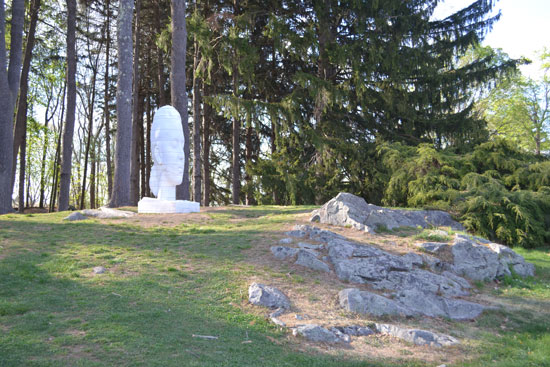
"Humming" by Jaume Plensa, 2011. Marble and lead. Artwork courtesy of Galerie Lelong (New York, NY).
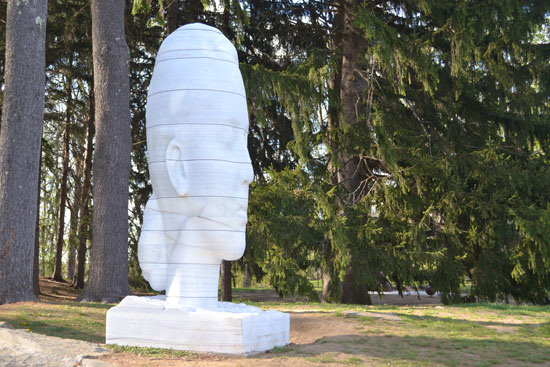
"Humming" by Jaume Plensa, 2011. Marble and lead.
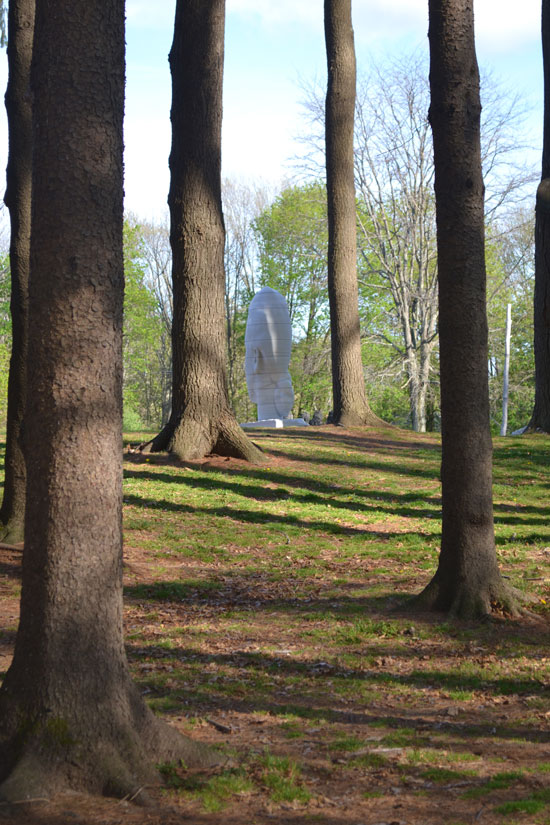
"Humming" by Jaume Plensa, 2011. Marble and lead. Artwork courtesy of Galerie Lelong (New York, NY).
.
Nearby, a bit of horror awaited. Tucked into a shaded wood was "Armour Boys" by Laura Ford. The installation is made up of five bronze figures of children swaddled in armour and prostrate by death. Tender and intimate, their gestures reveal a search for comfort in their final moments. Their childlike postures belie the steely armor that marks them as warriors for a King's cause.
Their far-flung placement in a nearly hidden wood is wrenching. These are the ones left behind. There is no witness that can retrieve them.
.
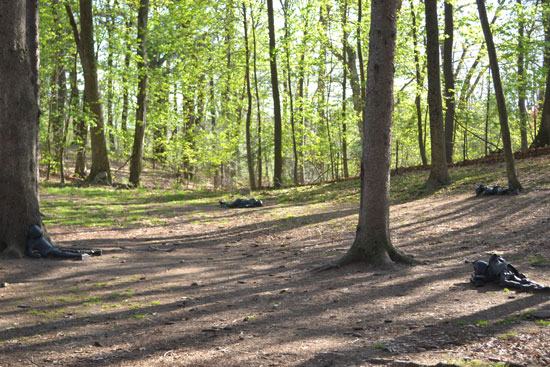
"Armour Boys" by Laura Ford, 2006. 5 figures, bronze, Edition 1/5.
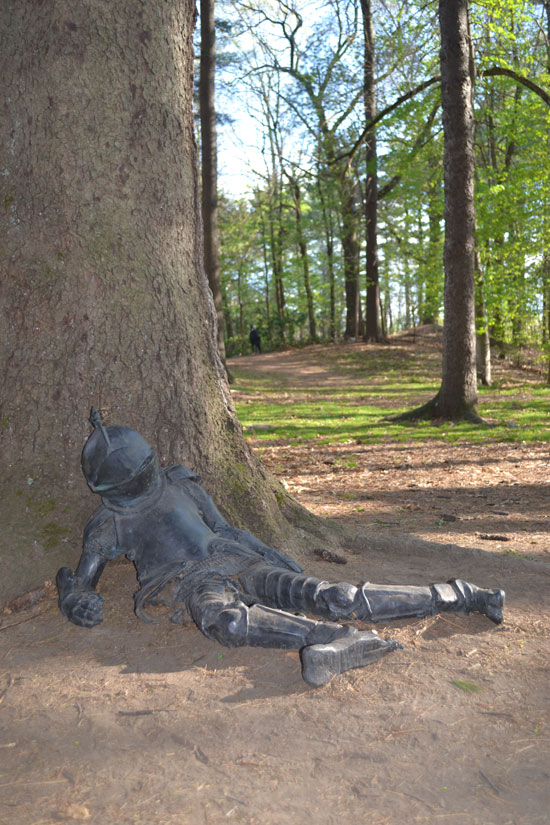
Detail of "Armour Boys" by Laura Ford, 2006. 5 figures, bronze, Edition 1/5.
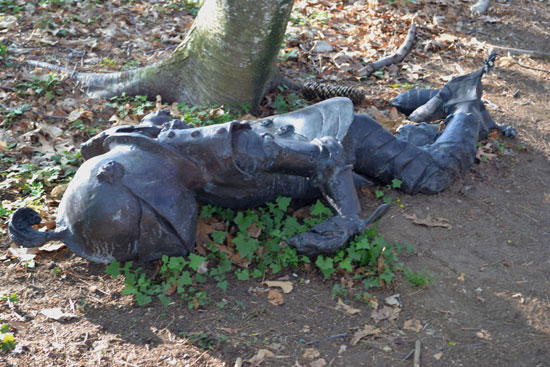
Detail of "Armour Boys" by Laura Ford, 2006. 5 figures, bronze, Edition 1/5.
.
"Requiem to the 20th Century" by Nam June Paik (1932-2006) was another favorite. Visually, the work is a bit startling with an aggressive silver dousing a 1936 Chrysler Airstream Sedan. A white suspended panel seems to be a cross between a bandstand cover and a wavy acoustical panel. Its motionless flapping was intriguing.
I found the beauty in "Requiem to the 20th Century" through my ears first. Mozart's final (and unfinished) composition "Requiem in D minor, K.626" plays continually and floats across the natural surroundings. Video panels replaced the windows in the windshield, the passenger side and the rear (but not the driver's side windows, which are part of the silver-colored surface). Images looped continually. Some seemed like a GPS having surrealistic dreams that sometimes turned psychedelic.
The contrast between the lofty classical music and the hard, practical edges of technology beckoned and asked for time to ponder the multiple meanings in the sculpture.
.
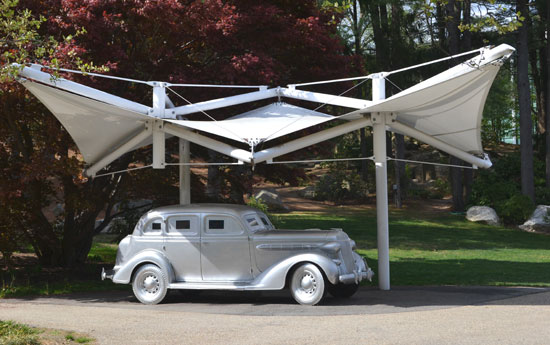
"Requiem to the 20th Century" by Nam June Paik (1932-2006), 1997. 1936 Chrysler automobile, video, audio, monitors and speakers.
.
The natural beauty found at deCordova Sculpture Park and Museum was also compelling. The combination of landscaped park, the nearby pond and the natural surroundings made it an incredible place to see sculpture.
.
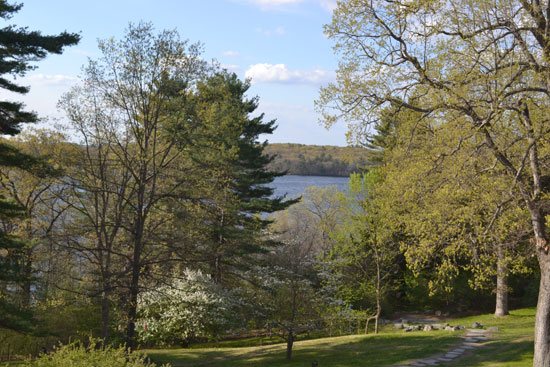
View of Flint
.
BASIC FACTS: The deCordova Sculpture Park is open daily from dawn to dusk. The museum is open Tuesday through Sunday from 10 a.m. to 5 p.m. A Cell Phone Audio Tour is available to provide insight into each artwork in the park and the museum. Recorded speakers include curators, gallery owners, art scholars, educators and the artist. In-person tours are also offered. For details, visit www.decordova.org.
The deCordova Sculpture Park is located at 51 Sandy Pond Road, Lincoln, MA 01773.
________________________________________
Copyright 2012 Pat Rogers and Hamptons Art Hub. All rights reserved.
Thanks for your road trip share. I agree with you the value of sculpture and this is a must attend biennial. Love the pictures too.
Great job Pat, as usual…….scott
Pat,
Thanks for the trip to the de Cordova that my current schedule does not allow, Lots of great work which I have not seen covered in other media. Looking forward to your next out of town adventure. BTW: you might have seen the enormous Plensa sculpture in Madison Park last year which was truly impressive on a scale that made made it equivalent to the tress surrounding it. No matter the scale, they live well in nature.
I missed the Plensa installation in Madison Park. Thanks for the info and for your insight. It sounds like it was tremendous (in size and in impact). The deCordova visit was the first time I had seen Plensa’s work. I’m glad for the experience.
Wow! How cool is this! We loved these sculptures – thank you very much!!We also appreciate yoru road trip, since we did not even know about it!
Pat, Thanks for this great blog. Every piece you showed us looks amazing. I wish I had taken the road trip with you. All the de Cordova Park needs to complete it is a huge pair of great white legs. I know where they can find some.
Funny! Sag Harbor Village, anyone?
Thanks for posting this for those of us who would otherwise not see it!